
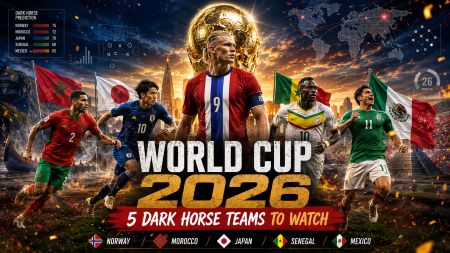
World Cup 2026 Predictions: 5 Dark Horse Teams That Could Shock the Favorites
World Cup 2026 predictions | FIFA World Cup betting insights | dark horse teams | tournament preview
Get expert World Cup 2026 predictions as we identify five dark horse nations capable of upsetting the tournament favorites. From Norway’s attacking firepower to Morocco’s defensive discipline and Mexico’s home advantage, these are the teams most likely to exceed expectations and make a deep run in the competition.
The 2026 FIFA World Cup is finally here — and for the first time, 48 nations will compete for football’s ultimate prize, up from the 32 teams we saw in all previous editions. This expansion means more matches, more drama, and far more fascinating head-to-heads, opening the door for upsets and unforgettable underdog runs — exactly like Morocco’s historic semi-final in 2022, South Korea’s fairytale on home soil in 2002, or Bulgaria’s breathtaking march to the semi-finals back in 1994.
When we look at the tournament favorites, the usual names sit right at the top: France, Spain, Brazil, Argentina, England, and a handful of others. But every World Cup throws up at least one side that outperforms all expectations, surges past the group stage, and takes down football’s biggest giants along the way. Sometimes it’s a host nation feeding off the energy of their fans; other times, it’s a carefully built squad — years in the making — finally ready to announce itself on the global stage.
This year, with 48 teams in the mix, three co-hosts in Mexico, the USA, and Canada, and several sides climbing rapidly up the FIFA rankings to sit comfortably among the traditional elite, the stage is perfectly set for surprises. Based on form, squad depth, tactical setup, and historical trends, here are the teams our data suggests you should watch closely — the true dark horses of World Cup 2026.
Norway
FIFA Ranking: 31st
Group: I | Opponents: Iraq, Senegal, France
Star Player: Erling Haaland (Manchester City)
Tactical Identity: High-tempo direct vertical play, with rapid, clinical transitions from defense to attack
Group Matches: vs. Iraq (June 16), vs. Senegal (June 22), vs. France (June 26)
Norway are back on football’s biggest stage after a 28-year absence, and they bring with them a golden generation that is more than ready to shake up the established order. Under manager Ståle Solbakken, they stormed through European qualifying with a perfect record — eight wins from eight games — while scoring an incredible 37 goals, more than any other side on the continent. Their attack is built around two world-class talents: striker Erling Haaland, who scored 16 goals in qualifying alone, and midfield maestro Martin Ødegaard, whose vision and control set the rhythm for everything they do.
Group I is undeniably tough, featuring defending champions France, African powerhouse Senegal, and a dangerous Iraq side. But Norway’s style is perfectly suited to tournament football: they defend as a tight unit, win the ball back quickly, and surge forward with speed and purpose. Ranked 31st in the world, their efficiency and physical strength make them a nightmare for any opponent. With Alexander Sørloth and Oscar Bobb adding further quality in attack, they have the tactical flexibility to exploit high defensive lines and punish even the smallest mistake — and they have more than enough firepower to go deep into this expanded World Cup.
Morocco
FIFA Ranking: 7th
Group: F | Opponents: Brazil, Scotland, Haiti
Star Player: Achraf Hakimi (Paris Saint-Germain)
Tactical Identity: Compact low-block defending, with explosive acceleration down the flanks to turn defense into attack
Group Matches: vs. Brazil (June 13), vs. Scotland (June 19), vs. Haiti (June 24)
Morocco enter World Cup 2026 as the highest-ranked African team on the planet, sitting 7th in the FIFA standings. They have built on their historic run to the semi-finals in Qatar by adding an AFCON title to their trophy cabinet, cementing their status as a genuine global force. Now led by Mohamed Ouahbi — who took charge in March 2026 — the Atlas Lions combine ironclad discipline with ruthless efficiency in front of goal. They were the first African nation to secure qualification, finishing top of their group with a dominant, unbeaten campaign.
Their leader is Achraf Hakimi: reigning African Player of the Year, fresh from Champions League glory, and arguably the best attacking full-back in the game. He is the heartbeat of their side, turning defense into attack in the blink of an eye. Behind him, experienced campaigners Yassine Bounou and Sofyan Amrabat provide stability and control, while rising stars like Ayyoub Bouaddi and Ismael Saibari bring energy and creativity. With Brahim Díaz pulling the strings in the final third, Morocco have the perfect balance: they can soak up pressure from the very best teams in the world, then strike back with devastating speed. They are not here just to take part — they are built to go all the way.
Japan
FIFA Ranking: 18th
Group: F | Opponents: Netherlands, Tunisia, Sweden
Star Player: Takefusa Kubo (Real Sociedad)
Tactical Identity: High-intensity, coordinated pressing, with intelligent control of space to force errors
Group Matches: vs. Netherlands (June 14), vs. Tunisia (June 20), vs. Sweden (June 25)
Japan have long been a consistent presence at World Cups — but in 2026, they are determined to finally break their long-standing curse of falling at the Round of 16. Everything suggests this is their strongest and most balanced squad yet. Under coach Hajime Moriyasu, the Samurai Blue have developed a style defined by intelligence, organization, and relentless work rate — even with key attacker Kaoru Mitoma sidelined through injury.
The spine of the team is elite: Liverpool’s Wataru Endo shields the defense and dictates tempo, supported by top-level defenders Hiroki Ito and Takehiro Tomiyasu. In attack, Takefusa Kubo’s flair, close control, and vision lead the line, alongside Ritsu Doan and Keito Nakamura — who has reached double figures in goals for his country. At 39 years old, legendary full-back Yuto Nagatomo brings unmatched experience, appearing in his fifth consecutive World Cup. Japan’s system is designed to suffocate opponents: they win the ball high up the pitch, control every inch of space, and punish mistakes instantly. Any team that underestimates them will pay the ultimate price: elimination.
Senegal
FIFA Ranking: 15th
Group: I | Opponents: France, Norway, Iraq
Star Player: Sadio Mané (Al Nassr)
Tactical Identity: Athletic mid-block defense, with powerful, direct attacks that overwhelm opponents physically
Group Matches: vs. France (June 16), vs. Norway (June 22), vs. Iraq (June 26)
Senegal remain one of the strongest footballing nations Africa has ever produced. They are the reigning African champions, and their squad is packed with players competing at the very highest level across Europe. Led by Pape Thiaw — part of the famous 2002 Senegal side that reached the quarter-finals — the Lions of Teranga blend raw athleticism with tournament-hardened experience. Drawn into a competitive Group I, they will relish the chance to test themselves against global giants and prove they belong in the conversation for the trophy.
Their team is built on world-class foundations: captain Kalidou Koulibaly is a commanding presence in defense, Edouard Mendy is one of the safest goalkeepers in the game, and Idrissa Gana Gueye controls the midfield with intelligence and bite. Up front, all-time top scorer Sadio Mané remains the talisman — a player capable of changing any game in a single moment. Alongside him, Bayern Munich’s Nicolas Jackson offers blistering pace, power, and ruthless finishing. Young talents like Pape Matar Sarr and Lamine Camara add energy and ball-winning ability, turning defense into attack in seconds. Built for endurance and intensity, Senegal are perfectly suited to the longer, more demanding format of the 2026 World Cup — and on their day, they can beat anyone.
Mexico
FIFA Ranking: 14th
Group: A | Opponents: South Africa, Republic of Korea, Czech Republic
Star Player: Edson Álvarez (Fenerbahçe)
Tactical Identity: High-pressing game optimized for altitude, built around a compact double pivot to control the midfield
Group Matches: vs. South Africa (June 11), vs. South Korea (June 19), vs. Czech Republic (June 25)
As one of the three co-hosts, Mexico carry the hopes of an entire nation — and they have every reason to believe 2026 could finally be their year. After a period of transition, El Tri brought back experienced manager Javier Aguirre for his third World Cup campaign, instantly restoring stability and confidence. They have risen to 14th in the FIFA rankings — higher than any other host nation — and have been handed a Group A that looks very favorable indeed. On home soil, they are strong favorites to advance comfortably.
Captain Edson Álvarez is the engine of this team: a tough, intelligent midfielder who shields the defense, wins the ball back, and drives play forward. In attack, experienced striker Raúl Jiménez links play and brings others into the game, while Santiago Giménez offers lethal finishing in front of goal. Between the posts, legendary goalkeeper Guillermo Ochoa competes in his sixth World Cup, alongside 17-year-old sensation Gilberto Mora — a perfect mix of proven legacy and bright future. Playing at the iconic Estadio Azteca, with its famous high altitude and electric crowds, Mexico’s high-pressing, compact style is designed to exhaust opponents over 90 minutes. This could finally be the tournament where they break past the Round of 16 and reach the quarter-finals — or beyond.
Honorable Mention: Colombia
FIFA Ranking: 13th
Group: K | Opponents: Portugal, DR Congo, Uzbekistan
Star Player: Luis Díaz (Bayern Munich)
Tactical Identity: Dynamic transitions down the wings, with a strong, physical central defense to shut opponents out
Group Matches: vs. Uzbekistan (June 17), vs. DR Congo (June 23), vs. Portugal (June 27)
Colombia are back at the World Cup with serious momentum, having missed out on the last edition. Under manager Néstor Lorenzo, they finished third in the brutal CONMEBOL qualifying group — ahead of giants like Uruguay and Chile — and currently sit 13th in the world. Group K offers a clear path to the knockout stages, with most analysts tipping them to progress comfortably.
Their squad is packed with talent. Playmaker James Rodríguez remains the creative heartbeat, with vision and set-piece quality that is still among the best in the world. But their biggest weapon is Luis Díaz: the Bayern Munich winger was their top scorer in qualifying, including a memorable two-goal haul against Brazil. Defensively, Jhon Lucumí and Davinson Sánchez form a tough, physical partnership that stops attacks before they even begin. Fast, strong, and always dangerous on the counter-attack, Colombia have every tool needed to cause major upsets.
Conclusion: World Cup 2026 Predictions Dark Horse Teams
The expansion to 48 teams changed the World Cup completely. Success is no longer just about having the best starting XI — it demands squad depth, physical fitness, and tactical flexibility over a longer, more grueling schedule. More than ever, the teams that go far will be those with strong defensive organization, speed in transition, and the ability to handle fatigue and pressure.
The five sides we have highlighted — plus Colombia — fit this blueprint perfectly. Norway’s relentless attacking power, Morocco’s defensive mastery, Japan’s discipline and intelligence, Senegal’s physical strength, and Mexico’s home advantage and intensity all give them the perfect platform to surprise the world. While the traditional giants battle against expectation and fatigue, these teams are ready to step up, rewrite the script, and become the unforgettable stories of World Cup 2026.